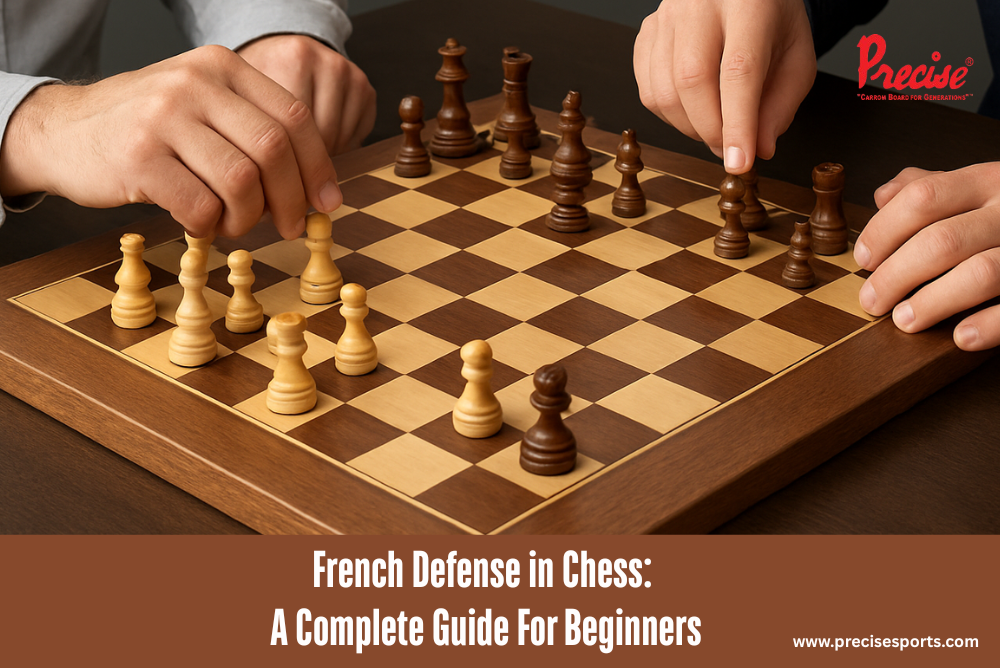
The French Defense in chess is one of the most trusted and time-tested strategies for players who want a strong response with the black pieces. Known for its solid structure and ability to counter White’s early moves, the French Defense helps beginners build a solid foundation in chess. This opening gives players the confidence to defend properly while also creating attacking chances later in the game.
In this blog, we will walk through everything a beginner needs to know about the French Defense. You will learn its history, the starting position, basic setup, strategies, variations, and common mistakes to avoid.We will also guide you on how to practice the French Defense effectively, and explain how to choose the right chess set from Precise Sports so that it supports your practice, helps you understand strategies better, and strengthens your overall learning experience.
What Is French Defense in Chess?
The French Defense in chess is a popular opening that begins with moves 1. e4 e6. It is a defensive strategy used by Black to challenge White’s center while keeping a solid pawn structure. Unlike aggressive openings that immediately go for attacks, the French Defense focuses on stability, counterplay, and long-term planning. For beginners, this opening is very useful because it teaches patience, smart defense, and timing for counterattacks.
By starting with the French Defense, new players can learn how to control the center, defend properly, and prepare for counter moves without falling into quick traps. It is widely played at both beginner and professional levels, making it a safe and smart opening choice for anyone starting their chess journey.
History of French Defense
The French Defense in chess has a rich history dating back to the 19th century. It first gained recognition when a group of French players used it successfully in correspondence games against opponents from England. Since then, the opening has carried the name “French Defense” and has remained a trusted choice for chess players around the world.
Many world champions and grandmasters have relied on the French Defense to face tough competition. Legends like Mikhail Botvinnik, Viktor Korchnoi, and Anatoly Karpov played it in important tournaments, proving its strength at the highest level. The defense is admired for its solid pawn structure, defensive reliability, and hidden attacking potential. For beginners, knowing its history adds extra motivation to study this opening and understand why it continues to be a strong and respected choice in chess.
Why Play the French Defense?
The French Defense in chess is a smart choice for beginners who want to build a strong base in the game. One of its biggest strengths is the solid pawn structure , which makes it harder for opponents to break through quickly. By playing 1…e6, Black prepares to challenge the center with d5, gaining balance between defense and counterattack.
Another reason to play the French Defense is that it helps players develop patience and strategic thinking. Instead of rushing into attacks, beginners learn how to slowly improve their position and wait for the right moment to strike. This defensive setup can frustrate opponents who prefer fast attacks, giving the French Defense player a psychological edge. Whether you’re playing at school, a chess club, or online, this opening is reliable and teaches valuable lessons about control, defense, and counterplay
Starting Position & Basic Setup for French Defense
The French Defense opening in chess begins with two simple moves: 1. e4 e6 2. d4 d5. After this, the game quickly takes shape, with White controlling the center using pawns on e4 and d4, while Black challenges that control with the pawn on d5. This creates a balanced fight where both sides aim to control the center squares.
For beginners, the setup is easy to understand:
- Black places pawns on e6 and d5 to build a solid wall.
- The light-squared bishop often develops to b4 or d6, depending on the variation.
- Knights are placed on f6 and c6 to support the center.
- The dark-squared bishop usually stays behind the pawn chain and gets developed later.
This structure gives Black a strong base and teaches new players the importance of pawn chains, central control, and piece coordination. By learning this basic setup, beginners can confidently start using the French Defense in their games.
Key Ideas and Strategies in the French Defense
The French Defense in chess is built on strong principles that make it reliable for both beginners and advanced players. To play it well, you must understand the main plans behind this opening. Below are the key strategies explained in detail.
Counterattack the Center
In many lines of the French Defense, White tries to push the pawn to e5, gaining space. Black often responds by playing c5, striking at the center. This counterattack helps Black break White’s strong pawn chain and create open lines for the pieces.
Use the Pawn Chain Wisely
The pawn structure in the French Defense usually forms a chain. For Black, the chain points toward the queenside, which means that side of the board is the natural area for counterplay. Meanwhile, White often uses the pawn chain to build attacks on the kingside. Understanding this difference gives beginners a clear map of where to play.
Strong Knight Placement
Knights are very powerful in the French Defense. The knight on f6 controls important central squares and supports counterattacks. The knight on c6 helps pressure the d4 pawn and prepares to expand on the queenside. Placing knights correctly makes Black’s position more solid and ready for both defense and attack.
Patience in Defense
Unlike fast attacking openings, the French Defense requires patience. Beginners learn to stay solid, wait for the right time, and then strike back . This patient style not only builds confidence in defense but also teaches long-term planning, a skill that helps in every stage of chess.
How To Reach the French Defense in Chess?
The French Defense in chess is one of the simplest openings to learn because it requires only a few moves to set up. What makes it powerful is not just the moves themselves, but the ideas behind them. Let’s break it down step by step so beginners can follow the reasoning clearly.
Step 1: White Starts with 1. e4
Most chess games at all levels begin with 1. e4, as this move opens lines for the queen and bishop while controlling important central squares. It’s an aggressive way for White to take space and start building a strong attack.
Step 2: Black Replies with 1… e6
By playing 1… e6, Black signals the start of the French Defense. At first glance, this move may look passive because it blocks the bishop on c8. However, the real idea is deeper: Black is preparing to challenge the center with the pawn move …d5. This defensive but flexible choice makes the French Defense unique.
Step 3: White Plays 2. d4
White pushes the pawn to d4, creating a strong duo of pawns on e4 and d4. This “pawn pair” gives White more space in the center and the possibility to attack quickly. At this stage, White’s position looks very active, but Black is ready with a counter.
Step 4: Black Strikes Back with 2… d5
Black answers with 2… d5, directly challenging White’s pawns. This is the key moment where the French Defense officially takes shape. Now both sides are fighting for control of the center. White can either defend, advance, or exchange pawns leading to different variations of the French Defense.
By remembering this move order 1. e4 e6 2. d4 d5 players can confidently enter the French Defense. More importantly, beginners should focus on the ideas: take space with White, defend and counter with Black, and always fight for the center. Understanding this principle will make learning the variations much easier.
French Defense Variations
The French Defense in chess has many variations, each leading to different types of positions. For beginners, knowing the main variations helps in choosing a style that fits their comfort level. These variations arise after the basic moves 1. e4 e6 2. d4 d5.
The Exchange Variation (3. exd5 exd5)
In this line, White captures the pawn on d5, and Black recaptures with the e-pawn. The result is a symmetrical position where both sides have equal pawns in the center. It is simple and safe, making it a good choice for beginners who want to avoid complex theory.
The Advance Variation (3. e5)
Here White pushes the pawn forward to e5, gaining space and trying to restrict Black’s knight on f6. Black usually responds with c5, attacking White’s center. This variation is useful for learning how pawn chains work and how to play on opposite sides of the board.
The Classical Variation (3. Nc3 or 3. Nd2)
In this setup, White develops a knight to c3 or d2 to protect the pawn on e4. Black continues with Nf6, directly challenging the center. This leads to rich and strategic battles where both players need to think carefully about pawn breaks and piece placement.
The Winawer Variation (3. Nc3 Bb4)
One of the most famous and sharp lines, the Winawer begins when Black pins the knight on c3 with Bb4 . This variation often creates double pawns for White and sharp, tactical battles. While it can be complicated, studying it helps beginners understand the power of pins and pawn weaknesses.
Summary
Each of these variations teaches different lessons in chess. Beginners can start with the Exchange or Advance Variation for simplicity and later explore the Classical or Winawer for deeper strategies.
Common Mistakes Beginners Make in French Defense
The French Defense in chess is solid, but beginners often make avoidable mistakes that weaken their position. Recognizing these common errors early helps players improve quickly.
Ignoring the Pawn Structure
One of the biggest mistakes is not understanding the pawn chain . In the French Defense, Black’s pawns on e6 and d5 create a chain that should guide the game. Moving pawns without thinking can create weaknesses and make it easier for White to attack.
Rushing Development
Beginners sometimes focus only on pawns and forget to develop knights and bishops . Delaying piece development can leave Black vulnerable, especially if White attacks the center or prepares a kingside assault.
Weak King Safety
Since the French Defense often starts passively, some players forget to castle early . Leaving the king in the center too long can lead to dangerous attacks from White.
Playing Without a Plan
Another common mistake is moving pieces randomly without a clear idea. The French Defense works best when players follow strategic ideas like counterattacking the center and controlling key squares. Moving pieces without purpose often leads to losing positions.
By avoiding these mistakes, beginners can use the French Defense more effectively, stay solid, and gradually improve their understanding of chess strategies.
Choosing the Right Chess Set for Practicing the French Defense
Practicing the French Defense in chess becomes much more effective and enjoyable with a high-quality chess set. A good set not only makes the pieces easier to see and handle but also helps beginners understand the positions and strategies clearly.
Precise Sports offers a variety of chess sets that are perfect for practicing openings like the French Defense:
-
Precise Champion Chessmen
The Precise Champion Chessmen are known for their durability and classic design, making them ideal for regular practice sessions. These chessmen provide stability on the board and ensure that beginners can practice openings repeatedly without distraction, building confidence with every game.
-
Precise Marshal Chessmen
The Precise Marshal Chessmen offer a perfect balance between weight and design, giving a comfortable and smooth playing experience. They are great for players who want to practice long sessions with consistent piece handling, making it easier to master the French Defense moves and variations.
-
Precise Maharaja Chessmen
The Precise Maharaja Chessmen combine luxury with functionality, perfect for players who enjoy a premium feel. The pieces are both visually appealing and practical, making learning the French Defense a more immersive and enjoyable experience.
Using any of these chessmen sets , beginners can easily set up the French Defense, try different variations, and gain confidence in their gameplay. A reliable chess set enhances focus, helps visualize strategies clearly, and makes practice more enjoyable.
FAQs
-
Can the French Defense lead to attacking opportunities?
Yes, while it is defensive, the French Defense allows counterattacks and tactical chances once the position stabilizes.
-
Is the French Defense commonly played at higher levels?
Yes, many grandmasters and world champions have used it successfully in top-level games.
-
Are the chess sets durable for regular practice?
Yes, each set is made with high-quality materials to withstand frequent use.
-
Are Precise Sports chess boards suitable for tournament use?
Yes, Precise Sports chess boards set are suitable for tournament use; many boards are tournament-approved and designed for smooth piece movement.
-
Can I carry these boards for travel or coaching sessions?
Yes, lightweight vinyl boards are portable and perfect for coaching, clubs, or online practice.
Conclusion
The French Defense in chess is an excellent opening for beginners who want to build a strong foundation in the game. It teaches players to balance defense and counterattack, control the center, and develop patience and strategic thinking. By understanding its history, variations, and key ideas, beginners can confidently navigate different positions and avoid common mistakes. Practicing consistently with the right setup helps in mastering the nuances of this time-tested opening.
Using a high-quality chess set and board from Precise Sports makes learning the French Defense even more effective and enjoyable. Whether it’s the Precise Champion Chessmen, Precise Marshal Chessmen, or Precise Maharaja Chessmen, these sets provide stability, durability, and an engaging playing experience. Pairing a reliable chess set with the right board allows beginners to visualize strategies clearly, try out variations, and gradually improve their chess skills , making each practice session both productive and fun.
